
The History of the Languedoc: Occitan, Occitania and the Troubadours Occitan is the Language of the Languedoc. Like most other southern European languages, it is a Romance Language. Its origin can be traced back to the tenth century, though like all Romance languages it clearly developed from Vulgar Latin. Occitan is sometimes represented as a dialect of French, or even as a corrupt form of French – a patois. Both of these ideas are wrong, though have been taught in French schools until recently. As philologists are fond of pointing out, this sort of error arises by regarding a language as “a dialect with an army”.
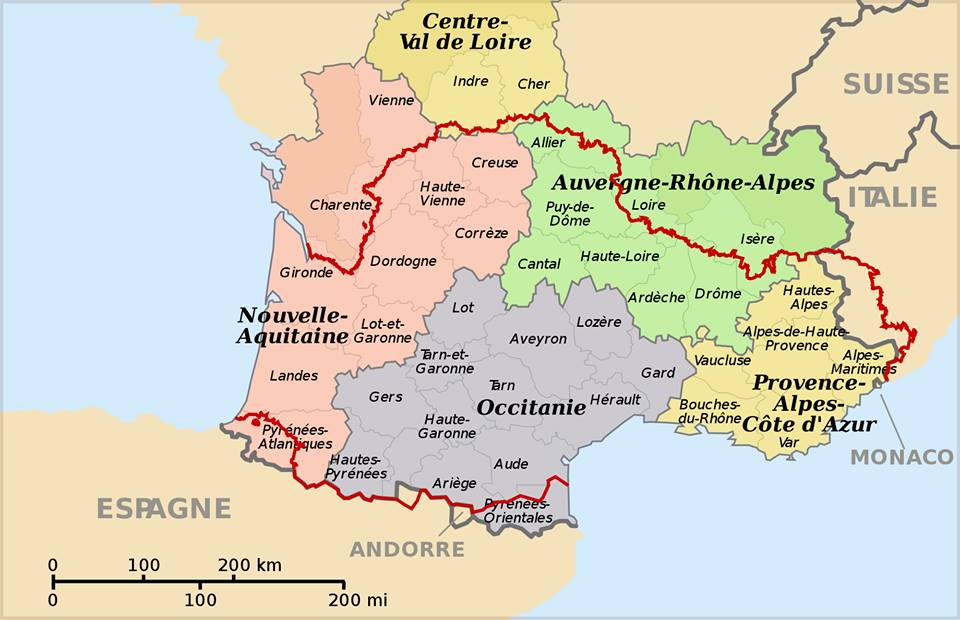
Map showing the area where Occitan s spoken.Historically, Occitan was spoken over a huge area – larger than the traditional French speaking area. It had a number of dialects, including Provençal. Occitan is also closely related to the Catalan language. Like “unofficial” languages elsewhere in Europe, the use of Occitan was actively discouraged for centuries in France, even suppressed. in the interests of imposing an official language to help bolster a nascent national identity. To avoid confusion between the present Languedoc (part of the Languedoc-Roussillon Region) and the Languedoc (the area of the langue d’oc where Occitan was traditionally the first language), the latter area is often called Occitania
It is easy now to underestimate the vitality and spread of the language. It was for example the first (and preferred) language of King Richard I of England (the Lionheart), as well as of his mother Eleanor of Aquitaine. Occitan was the first literary language of modern Europe, the language of the Troubadours. The Occitan legacy of the Troubadours constitutes one of the greatest literary treasures of Europe. To appreciate the beauty of the language and the surprisingly modern tone of their poetry, you might like to read a short Troubadour song, written by a woman over eight hundred years ago.
Despite efforts by the French state to suppress Occitan, it still survives. Indeed, it has undergone a revival in the last few years, so you can learn a little about Occitan today.

Bogomils stone

 Želim da skrenem pažnju da smo postojali i prije nego sto smo postali srbi, muslimani, hrvati, bošnjaci i ostali. Bili smo jedan moćan narod sa svojim jezikom, znanjem, duhovnim školama, spomenicima i sjećanjima za koje nas ubjeđuju da su nešto drugo …
 Damir na divanu
I truly appreciate this post.Much thanks again. Will read on…
LikeLike
Good day! Do you know if they make any plugins to assist with SEO?
I’m trying to get my blog to rank for some targeted keywords but I’m not seeing very good results.
If you know of any please share. Cheers!
LikeLike
Thanks for the blog.Much thanks again. Will read on…
LikeLike
naturally like your web-site but you need to check the spelling
on quite a few of your posts. Many of them are rife with spelling problems and I to find
it very bothersome to tell the reality on the
other hand I’ll surely come again again.
LikeLike
Ahaa, its good dialogue on the topic of this piece of writing here at this website, I have read all that, so now me also commenting here.
LikeLike
Hi, i feel that i saw you visited my web site so i
came to return the choose?.I am trying to in finding issues
to enhance my site!I assume its good enough to use a few of your
concepts!!
LikeLike
I value the blog.Really thank you! Want more.
LikeLike
Wonderful beat ! I wish to apprentice at the same time as you amend
your web site, how can i subscribe for a blog website?
The account helped me a acceptable deal. I were a little bit
acquainted of this your broadcast provided brilliant clear idea
LikeLike
Hi there, after reading this awesome post i am also glad to
share my knowledge here with friends.
LikeLike
It’s difficult to find knowledgeable people in this particular subject, but you seem like you know what you’re talking
about! Thanks
LikeLike
Really informative blog.Thanks Again. Cool.
LikeLike
I go to see every day a few web pages and sites to read articles, however this blog offers feature based content.
LikeLike
Im grateful for the blog article.Thanks Again. Fantastic.
LikeLike
A big thank you for your blog.Really looking forward to read more.
LikeLike
Say, you got a nice blog. Cool.
LikeLike
Thank you for your article post. Cool.
LikeLike
Thanks for sharing, this is a fantastic post.Really thank you! Really Cool.
LikeLike
Enjoyed every bit of your blog.Really thank you! Great.
LikeLike
A big thank you for your blog post.Really thank you! Really Cool.
LikeLike
Good info. Lucky me I came across your blog by accident
(stumbleupon). I have saved as a favorite for later!
LikeLike
When some one searches for his essential thing, so he/she needs to
be available that in detail, thus that thing
is maintained over here.
LikeLike
Undeniably consider that that you stated. Your favorite reason seemed to be
at the web the simplest thing to remember
of. I say to you, I definitely get annoyed
even as other folks consider concerns that they plainly don’t
know about. You managed to hit the nail upon the highest and also defined out
the entire thing without having side effect , other people could take a signal.
Will probably be back to get more. Thanks
LikeLike
Thanks so much for the post.Really thank you! Really Great.
LikeLike
Really informative blog article. Really Great.
LikeLike
Thanks for the post.Really thank you! Will read on…
LikeLike
Muchos Gracias for your blog post. Great.
LikeLike
Im thankful for the blog article.Really looking forward to read more. Keep writing.
LikeLike
Really appreciate you sharing this blog.
LikeLike
Good day I am so glad I found your site, I really found
you by error, while I was looking on Bing for something else, Nonetheless I am here now and
would just like to say thank you for a marvelous post and a all
round thrilling blog (I also love the theme/design), I don’t have time
to go through it all at the minute but I have saved
it and also added in your RSS feeds, so when I have time I will be back to read more, Please do keep
up the awesome jo.
LikeLike
What’s up to all, the contents existing at this site are in fact remarkable for people knowledge, well, keep up the nice work fellows.
LikeLike
I used to be able to find good info from your articles.
LikeLike
Hey There. I found your weblog using msn. That is a very neatly written article.
I’ll make sure to bookmark it and come back
to learn extra of your helpful information. Thank you for the post.
I’ll certainly return.
LikeLike
We stumbled over here coming from a different web page and thought I might check things out.
I like what I see so i am just following you. Look forward to exploring your web page repeatedly.
LikeLike
Great, thanks for sharing this post.Much thanks again. Will read on…
LikeLike
Thanks for sharing, this is a fantastic blog post.Much thanks again. Great.
LikeLike
I pay a visit day-to-day a few sites and websites to
read posts, however this webpage presents feature based writing.
LikeLike
Major thankies for the post.Much thanks again. Really Great.
LikeLike
This is one awesome article post.Thanks Again. Really Cool.
LikeLike
Thank you ever so for you article post.Really thank you! Really Cool.
LikeLike
Thanks for the article post.Thanks Again. Will read on…
LikeLike
Wow, amazing blog format! How long have you ever been running a blog for?
you made blogging glance easy. The full glance of your web site is fantastic, as well as
the content material!
LikeLike
Thank you ever so for you blog post.Thanks Again. Want more.
LikeLike
Looking forward to reading more. Great article. Really Great.
LikeLike
A big thank you for your post.Really looking forward to read more. Really Great.
LikeLike
This is one awesome blog post.Much thanks again. Will read on…
LikeLike
I cannot thank you enough for the article post.Thanks Again.
LikeLike
Hey, thanks for the blog post.Really thank you! Fantastic.
LikeLike
Great, thanks for sharing this post.Much thanks again. Will read on…
LikeLike
Hey, thanks for the blog article.Much thanks again. Much obliged.
LikeLike
Hey, thanks for the article post.Much thanks again. Cool.
LikeLike