

So, this is just a part of my story which start long, long ago about Bosnia and nowadays surrounding countries through the time line…
When we’re talking about Bosnian mythology it is important to clarify instantly the following – Bosnian people are speaking a Slavic language, but this doesn’t mean that they are Slavic people, since according to that logic the Mexicans would be Spaniards, Brazilians would be Portuguese and for example the Algerians or Moroccans would be French. Thesis about the southern Slavs, which is based exclusively on the Slavic language is as it’s historically known, a merit of the European colonial forces, primarily Great Britain and Austro-Hungary, which disintegrated Balkan people in order to manipulate them better, they enforced numerous historically catastrophic thesis, primarily about the affiliation to the Slavs. We won’t even notice genetic research which proved that there is a dominant Illyrian gene present when compared to all others. But, one of the strategical interests was stimulating nationalism, in order to place this strategically important part of Europe under their sphere of influence, using the primitivism which was traditionally rooted among the Balkan people. In order to more clearly explain what I’m talking about let us remember this historical fact which states: how is it possible that the people of the Balkans, which existed between two great civilizations, Greece and Rome, never managed to achieve a cultural or civilization advancement. Everything that was created in the previous centuries in this area is a result of all other people besides the Balkan ones, starting from the Greeks, Romans, Vizigoths, Ottomans, Austro-Hungarians. whether we like it or not, the answer is simple – primitiveness was always a dominant trait of this part of Europe.
History has shown as well as proved that the people which can be manipulated the easiest are primitive ones.
In order to grasp the pagan world of our ancestors, especially the one connected with their religious life, we need to gather all the names of the god’s and goddesses of the Illyrian pantheon from the entire area of Illyricum from today Greece, Albania across Bosnia and Herzegovina to Slovenia. Individual deities had several names but an identical function which is the reason why the Illyrians failed to establish a unique religion across the territory of Illyricum and why it was divided into many cults.
But, according to all available data, worshiping the snake, the reincarnation of the Grand Mother, Thane and Vidasus were common to all Illyrian tribes mostly because these deities were connected with the cult of agriculture and fertility.

God Dracon and goddess Dracaena, divine couple.
The serpent was a powerful symbol among the ancient Illyrians, in particular
among those of the southern Balkans. In the Roman period, there were altars in Dardania dedicated to the serpent pair, Dracon and Dracaena.
cf. H. Pedersen 1898 .
Goddess Nutrika, protector of children…
Goddess Sentona, goddess tied to the cult of agriculture.
Also mention in Moesin Celtic tradition…
Goddess Ika, goddess of fertility.
In Paleo Balkan mythology known as nymph Ica sundown
Goddess Histria, goddess, protector of the entire geographical area of Istria.
Also a Gallic goddess of land.
God Boria, god of wind.
A god of the North Wind in Moesin Celtic tradition.
„Some deities are known exclusively from Istria, such as Eia, Malesocus, Boria and Iria” Wikipedia
Goddess Nebra, goddess of storms and mist.
Nebra disc in Celtic Calendar representing what we celebrate today as Halloween.
Goddess Trita, goddess of health.
Her name has no connection to the Istria area, instead it can be recognized in the names from Bosnia and Herzegovina, in the form Tritan, Tritanon or Traitano.
It is believed that the name of the goddess has an Illyrian-Celtic heritage.
God Melosok – local Illyrian god, protector…
Goddess Anzotika, Irija or Prende, goddess of love.
https://en.wikipedia.org/wiki/Prende
God Boa, divine snake…
God Verbti, god of fire and the north wind which causes fires.
Known as “the holy blind one”.
Beautiful celestials (in Albanian: Bukuri and Qiellit) in ancient Illyrian times, three gods which divided the world into the heavens, sea and underground.
God Medauros or Armatos, god of war.
Medaurus or Medauros was a protective deity worshiped by Illyrians in the town of Rhison (Risan, Montenegro) at the Gulf of Kotor. He was mentioned in a dedication at Lambaesis in Africa by a roman senator and native Risinium. He appears to be identical to the Thracian horseman, riding on horseback and carrying a lance.
The Delmatae, famous Illyrian tribe had Armatus as a god of war
God Redon, protector of seafarers.
God in the form of a boy next to which a dolphin appears.
God En, one of the three supreme gods.
https://en.wikipedia.org/wiki/En_(deity)
En was demoted to demonic status following the arrival of Christianity in Illyria, and continues to be used in the Albanian language to refer to Thursday (Albanian: Enjte)
God Perendi or Shurdi, god of the thunder, husband of the goddess Prende.
https://en.wikipedia.org/wiki/Perendi_(deity)
A curious similarity appears between the “Slav” name of the god of thunder Perun and the Illyrian Perendi. If we take into consideration that the Illyrians, besides the Greeks, are the oldest people in the Balkans then it is easy to conclude that Perendi or Perin is nothing more than an ancient Illyrian deity which is wrongly connected with the forced Slav pantheon.
About this God I am preparing separate story !
Goddess Thana, Tana, Thiana or Zana (Albanian)
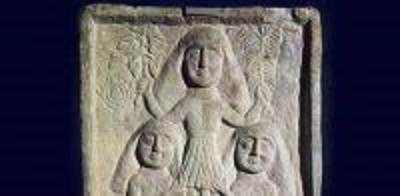
Illyrian goddess equated to the Roman Diana. She is followed by three goats with golden horns. In Albanian mountains Zana lives as a fairy adorned by bravery and beauty. Among the Bosnians Zana or Tana is a forest fairy (Zlatna) which lives in Bosnian forests and helps great warriors, such as Mujo Hrnjica.
Deep connection of the goddess Tana is evident through folk songs where the scene of Mujo Hrnjica meeting with the faeries is described, the fairies were disguised as goats, with his shrewdness he manages to unmask them and subject them to his will. Even though in Bosnian mythology it is considered that the forest fairy and Zlatna are actually two different faeries i.e. mother and daughter, we are probably talking about one fairy which probably has a different name in various parts of Bosnia and Herzegovina. Identification of the Illyrian goddess in the name of the queen of faeries Zlatna (Zlatana) is more than evident in the name itself, namely, if we subtract first three letters from Zlatana we will get the name Tana or if we subtract the second, third and fourth letter – Zana.
Zlatna is called forest or mountain fairy in north-western part of Bosnia with clear meaning of mountain i.e. forest fairy or forest mother. Her epithet of queen, confirms her privileged position which she has as the goddess of our Illyrian forefathers.

Altar of Vidasus and Thana fromTopusko, Archaeological Museum in Zagreb
God Vidasus or Vidas,
One of the names of this grand god of the Illyrian pantheon is Messor or Žtalac which clearly alludes to his dominant role in the cult of fertility i.e. agriculture.
Time of harvests was a period dedicated to him.
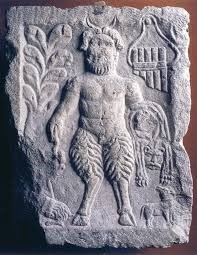
Vidasus is the god of forests and nature, and together with the goddess Thana the deity of fertility. He was worshiped under various names, at some places as Vidasus, elsewhere as Magla (enus?), or Cor… Messor and the like.
This name Cor is unusually reminiscent of the Celtic god Cernunnosa which had an identical description. Similarly, it is presumed that with this Illyrian deity the famous name Grabovius is connected (where from our Illyrian word grab (hornbeam) stems from), which is mentioned on the so called Iguvine tablets from Umbria in Italy. Given that on the same monument the name Japuzkum (Japudiscum) nomen is mentioned – the enemy of the Umbra – we conclude that the Umbra took the name Grabovius (this epithet comes with thename Jupiter, as well as that of Mars and Vovionus) from the Japodes. It is considered that Vidasus, or Romanised Silvan, was the supreme Illyrian god in the period before Rome, and he also kept that function after it. The Roman’s accepted him and equated with the Greek Pan the protector of forests, flocks and nature and a companion during hunting. Visual depictions of the Illyrian Vidasus depict him as a being which is half goat and half man. Vidasus was worshiped during the beginning of the lighter part of the year, at the end of April and beginning of May.
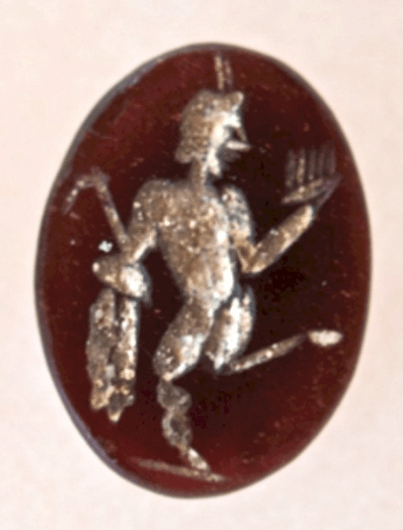
An engraved gem of amber, depicting the god Vidasus (Romanian – Silvanus), Huremovač, Ljubuši, south-western Bosnia and Herzegovina.
Sculptures which depict god Vidasus, sometimes accompanied by Tana, show him encircled by girls dancing or in the form of nymphs, water faeries. Beside the data which confirm that the Bosnian folk were familiar with faeries from ancient times, this information is extremely important for further study about correlation with persons which came into direct contact with faeries and gained healing powers as well as texts of spells. From Bosnian tradition we know that faeries are skilled in healing with medicinal herbs and spring water in which, according to legends, they would bathe.
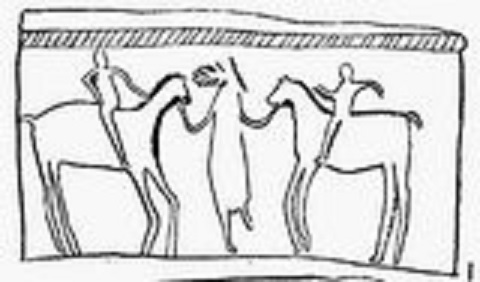
God Vidasus on Bosnian Stecak
God Bindu was the god of springs
Ancient beliefs of the Illyrian tribes which inhabited Bosnia and Herzegovina remained present in folk beliefs, mostly connected to the cult of water healing, in which the god Bindu is clearly manifested. When one analyses the folk cult of healing and the practice of it, which is essentially pagan in nature, then it is difficult to explain how that ancient system managed to survive in Bosnia especially in the midst of a strong expansion of Christianity and later Islam?! However, the answer should besought in the fact that Christianity, especially after the appearance of Bogomils, or Islam had enough influence to fully assimilate the Bosnian people and to fully disengage them from the ancient Illyrian religion. And that it is true is perhaps best shown by the cult of god Bindu. As it is known god Bindu was the god of springs of the Bosnian Illyrians whose spring-temples were found all over modern Bosnia and Herzegovina and the neighboring Croatia. One of the best preserved holly places was found in Privilice near Bihaćwhich is located in nature, next to a spring.
At that location dozens of dedicated sacrifices to Bindu were excavated, as well as a chapel with numerous animal bones sacrificed in his honour.In the ritual practice of pilgrimage towards springs one can notice the influence of three religious cults of the Bosnian Illyrians: cult of the sun, cult of the moon and cult of Bindu. Cult of the sun: the largest number of holly and salutary springs are located on the east side of the settlement. One would visit it exclusively at dawn, before sunrise, in order to pray, wash one’s face and drink water. In such a way the diseased would expect the blessing of the sun which would shine the light and warmness on the person once it rose from the east.Cult of the moon: the holly springs were visited in the first week of the new moon, precisely on odd days i.e. Monday, Wednesday, Friday and Sunday.Cult of Bindu: after washing their faces and drinking water or placing it into vessels and carrying ithome, the diseased would leave some money next to the streams, usually coins, food, eggs or they would hang some of their clothes on the nearby branches.In the mentioned descriptions of rituals one can notice influences of three deities, which could point to the fact that Bindu was the son of the sun god and moon goddess and as their son he represented the perfect example of vitality and health which gives life and defeats evil, in this case over diseases. The sun that would appear in the east in the morning, according to folk belief the sun was “born”, and the first seven days after the appearance of the new moon undoubtedly point to the idea of renewal of life energy, health and generally luck and prosperity. The sick would ask for blessings from the heavenly deities who again resurrected in their eternal cycles and the manifestation of their divine power was exactly the water over which Bindu had patronage and power.During the beginning of the 20th century, Emilian Lilek, a professor from Sarajevo, recorded a dozen examples of spring worshiping in Bosnia, the springs were equated with healing powers. His ethnological work has been published in the National Museum BIH under the title “Religious antiquities from Bosnia and Herzegovina” in the chapter “Water worship”. Examples that professor Lilek gathered and recorded have, besides their ethnological value, a historic significance because they confirm the long practice of worshiping the cult of god Bindu, deity of the Bosnian Illyrians to whom spring were dedicated i.e. natural temples.
It is clear that the Bosnian people haven’t forgotten about the religious practice of their ancestors which survived despite numerous restless decades which were characterized by the arrival of the Slavs and monotheism.
In all of the descriptions one can clearly see the practice of pilgrimage towards the streams whose water was considered to have healing properties as well as the practice of leaving money as a gift, food or a piece of clothing which was a substitute for human or animal sacrifice.Behind such a ritual there existed a belief in a supernatural being, whose name was forgotten by the people, and to whom a sacrificial offering had to be made in order to get help i.e. help from disease.The following are only some of the examples given by professor Lilek: On the left side of the river Miljacka there is a spring Pišć-water, from which you mustn’t drink until you leave some money next to the stream or a piece of one’s clothing. Bosnian women visit Pišć-water before sunrise, leaving money next to the spring, and tying pieces of clothing onto the branches of the willow next to the stream.Catholic women visit the stream above Kovačvićbefore sunrise and leave some money there.In Tešnj there is a stream outside the city where the Bosnian women bring their sick children, and bathe them in that water. When they head home they leave some money next to the stream, or they take off a piece of clothing from the child and leave it next to the spring.In Travnik there is a spring called Safa’s source and it is visited by Muslim’s and Christian’s alike,especially around May 6th, in particular those that have headaches or fever. They bathe themselves at the spring. When they head home they throw some money in the water or leave a piece of clothing there.In Pritoka next to Bihaćthere is a spring which is visited by sick people in order to bathe in it. If a diseased arrives who is also a sinner, the water from the spring disappears immediately, but if a man without large sins comes the water appears in order for him to bathe in it. The spring is gifted with money, clothes, etc.Next to Modrič there is a spring called Ščra. When someone has a fever, one visits the spring in the first week of the new moon’s appearance, Wednesday or Friday, and it bathes in its waters before sunrise. One leaves some money next to the spring or hangs a piece of its clothing onto a tree next tothe spring.In Tuzla there is a spring called Istočik, Christians visit it during Friday or Wednesday, in the firs tweek of the new moon’s appearance. They bathe at the spring and leave some money or some food.
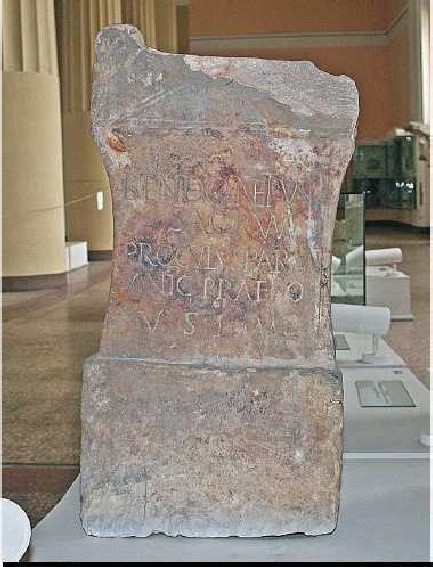 Altar with dedication to Bindus Neptune from Privilica, National Museum in Sarajevo.
Additionally I can add some of conclusions from Mirjana Sanader s book about Cults in the territory that today makes up the Republic of Croatia :
„The majority of the indigenous cults were not fully Romanized, because the interpretatio Romana has only been ascertained in the case of a few local deities. This applies, for instance, to Anzotica and Iria, deities who were recognized in the Roman Venus, or to Bindus, who was equated with Neptune.
A portion of the domestic deities experienced only a lesser, perhaps simply formal, degree of adaptation, so besides their domestic name they were accorded the epithet Augusta, such as, for example, the Histrian goddess Eia Augusta. We can only speculate as to the reasons for the absence of syncretization of most indigenous cults with their Roman counterparts. Medini cited the inadaptable nature of domestic deities as a reason, but just their precise nature is still not entirely known.
Additionally, the actual visualization of these domestic, indigenous deities remains unknown. The reasons lies in the fact that traces and evidence of them have only been preserved in inscriptions. Therefore, it is even possible that the domestic population saw some of them as supernatural forces without a specific image. In the case of certain other deities – those which became syncretized with Roman deities – similarities with the Roman pantheon were found. According to the evidence, the majority of indigenous cults came from the territories inhabited by the Histri and Liburni. Worship of only a single cult was recorded among the Japodes, involving the god Bindus who was, as stated, equated with the Roman Neptune.
The Colapiani worshipped the divine couple Vidasus and Thana, whose Roman versions are still not known. Analysis of the distribution of individual cults indicates that most of them were restricted to local communities. Examples are the cult of the goddess Latra, who appears only in Nadin and its immediate environs, while evidence of veneration of the goddess Anzotica can only be found in Nin.
The indigenous deities among the Liburni were exclusively female.
Among the Histri cults were also mostly dedicated to goddesses, with the exception of the god Melosocus. Experts have linked this fact – at least in the case of the Liburni – to the Liburnian social order, about which we know from the texts of Classical writers. Thus, in the Periplus (21) of Pseudo-Scylax, among others, we can read that the Liburni were ruled by women. Other writers also spoke of some sort of matriarchy, which even survived into Roman times in familial charts which followed the female lineage (Varro, r.r. 2, 10,9; Plin., N.H. 3, 139-141).
It is interesting that the dedicants who dedicated these monuments were not only members of the indigenous population but also immigrants, which indicates a certain degree of religious tolerance in Roman society.”
Still a lot of work to do, so this story will be continue …
 Želim da skrenem pažnju da smo postojali i prije nego sto smo postali srbi, muslimani, hrvati, bošnjaci i ostali. Bili smo jedan moćan narod sa svojim jezikom, znanjem, duhovnim školama, spomenicima i sjećanjima za koje nas ubjeđuju da su nešto drugo …
 Damir na divanu
This site was… how do I say it? Relevant!! Finally I have found something that helped me. Kudos!
LikeLike
Hi there! Do you use Twitter? I’d like to follow you if
that would be ok. I’m definitely enjoying your blog and look forward to new posts.
LikeLike
Awesome article.
LikeLike
Great article.
LikeLike
You made some really good points there. I checked on the web to learn more about the issue and found most people will go along with your views on this site.
LikeLike
Hey there, You’ve done an excellent job. I will certainly digg it and personally suggest to my
friends. I’m confident they’ll be benefited from this web site.
LikeLike
I’m extremely impressed with your writing skills as
well as with the layout on your weblog. Is this a paid theme or did you modify it yourself?
Either way keep up the nice quality writing, it’s rare to
see a great blog like this one today.
LikeLike
Hello, I enjoy reading through your post. I like to write
a little comment to support you.
LikeLike
I’m curious to find out what blog platform you are utilizing?
I’m having some small security problems with my latest blog and
I’d like to find something more safeguarded. Do you have
any suggestions?
LikeLike
My brother recommended I might like this web site. He used to be totally right.
This post actually made my day. You can not believe simply how much time I had
spent for this info! Thanks!
LikeLike
Really when someone doesn’t know afterward its up to other people that they will help, so here it takes place.
LikeLike
Hi my family member! I wish to say that this article is amazing, great written and come
with approximately all important infos. I would like to see extra posts like
this .
LikeLike
Hey! Do you know if they make any plugins to assist with Search Engine Optimization? I’m trying to get my blog to
rank for some targeted keywords but I’m not seeing very good results.
If you know of any please share. Thanks!
LikeLike
What i do not realize is in reality how you are now not really a lot more well-favored
than you might be right now. You’re so intelligent. You already know therefore considerably in the case of this subject, made me in my opinion imagine it from a
lot of various angles. Its like men and women don’t seem to be involved until it is something to accomplish with Woman gaga!
Your individual stuffs excellent. Always handle it
up!
LikeLike
I am regular reader, how are you everybody? This article posted at this site is truly pleasant.
LikeLike
I couldn’t resist commenting. Exceptionally well written!
LikeLike
This info is worth everyone’s attention. How can I find out
more?
LikeLike
Fastidious answer back in return of this matter with real arguments and describing everything about
that.
LikeLike
My spouse and I stumbled over here different page and thought
I should check things out. I like what I see so i am just following you.
Look forward to looking into your web page again.
LikeLike
Does your blog have a contact page? I’m having trouble locating it
but, I’d like to send you an e-mail. I’ve got some creative ideas for your blog you might be interested in hearing.
Either way, great blog and I look forward to seeing
it develop over time.
LikeLike
Very neat article post.Really looking forward to read more. Awesome.
LikeLike
Thanks to my father who stated to me on the topic of this web site, this blog is genuinely remarkable.
LikeLike
Hey! Do you know if they make any plugins to safeguard against hackers?
I’m kinda paranoid about losing everything I’ve worked hard
on. Any tips?
LikeLike
It’s very simple to find out any topic on web as compared to books,
as I found this post at this site.
LikeLike
Hi Dear, are you truly visiting this website regularly, if so after that you
will definitely obtain fastidious experience.
LikeLike
Wow that was odd. I just wrote an extremely long comment but after I clicked submit my comment didn’t appear.
Grrrr… well I’m not writing all that over again.
Regardless, just wanted to say superb blog!
LikeLike
Can I simply say what a relief to uncover an individual who really knows what
they are talking about on the net. You definitely realize how to bring
a problem to light and make it important. A lot more people really need to
read this and understand this side of the story. I can’t believe you are
not more popular because you surely have the gift.
LikeLike
My brother recommended I might like this blog. He was once entirely right.
This put up truly made my day. You cann’t believe
just how much time I had spent for this information! Thanks!
LikeLike
I was able to find good advice from your articles.
LikeLike
Pretty! This was an incredibly wonderful article. Many thanks for providing this information.
LikeLike
This blog was… how do I say it? Relevant!! Finally I’ve found something which helped me. Appreciate it!
LikeLike
whoah this blog is wonderful i like studying your articles.
Stay up the good work! You know, many people are
searching around for this info, you could aid them greatly.
LikeLike
Thanks for the marvelous posting! I quite enjoyed reading it, you might be
a great author. I will make certain to bookmark your blog and will eventually come back from now on. I want to
encourage you continue your great posts, have a nice morning!
LikeLike
I like the helpful info you provide in your articles.
I will bookmark your weblog and check again here frequently.
I’m quite sure I will learn a lot of new stuff right here!
Best of luck for the next!
LikeLike
I truly love your blog.. Very nice colors & theme. Did you make this site yourself? Please reply back as I’m wanting to create my own blog and would like to know where you got this from or what the theme is called. Appreciate it!
LikeLike
Do you have a spam problem on this site; I also am a blogger,
and I was wanting to know your situation; many of us have created some nice methods and we are looking to trade strategies with other folks, why
not shoot me an email if interested.
LikeLike
Hello, just wanted to say, I liked this blog post. It was practical.
Keep on posting!
LikeLike
Outstanding story there. What happened after? Thanks!
LikeLike
Hi! Someone in my Myspace group shared this site with us so I came to look it over.
I’m definitely loving the information. I’m bookmarking and will be
tweeting this to my followers! Terrific blog and superb style and
design.
LikeLike
Its like you learn my thoughts! You seem to understand a lot about this, such as you wrote the ebook in it or
something. I think that you simply can do with some % to pressure the message house
a little bit, but other than that, that is fantastic blog.
An excellent read. I’ll definitely be back.
LikeLike
I visited multiple web pages except the audio feature for audio songs current at this web page is
truly wonderful.
LikeLike
Greetings! Very helpful advice within this post! It’s the little changes which will make the biggest changes. Many thanks for sharing!
LikeLike
Hmm is anyone else experiencing problems with the images on this
blog loading? I’m trying to determine if its a problem on my end or if it’s the blog.
Any suggestions would be greatly appreciated.
LikeLike
I have read so many articles regarding the blogger lovers except this post is genuinely a pleasant piece of writing,
keep it up.
LikeLike
Hello Dear, are you actually visiting this web page regularly, if so after that
you will without doubt obtain pleasant knowledge.
LikeLike
With havin so much content and articles do you ever run into any issues of plagorism
or copyright infringement? My site has a lot of unique content I’ve either created myself or outsourced but it appears a lot of it is popping it up all over the web without my permission. Do
you know any methods to help reduce content from being stolen? I’d truly
appreciate it.
LikeLike
Hi to all, for the reason that I am really keen of reading
this website’s post to be updated daily. It carries fastidious information.
LikeLike
Wonderful article! We are linking to this great content on our website. Keep up the great writing.
LikeLike
Everything is very open with a really clear clarification of the challenges. It was definitely informative. Your site is useful. Many thanks for sharing!
LikeLike
I could not resist commenting. Perfectly written!
LikeLike